• Blog
  • Inquiry Archive
  • About
Menu

Inquiry Of The Day (IOTD)365

  • Blog
  • Inquiry Archive
  • About

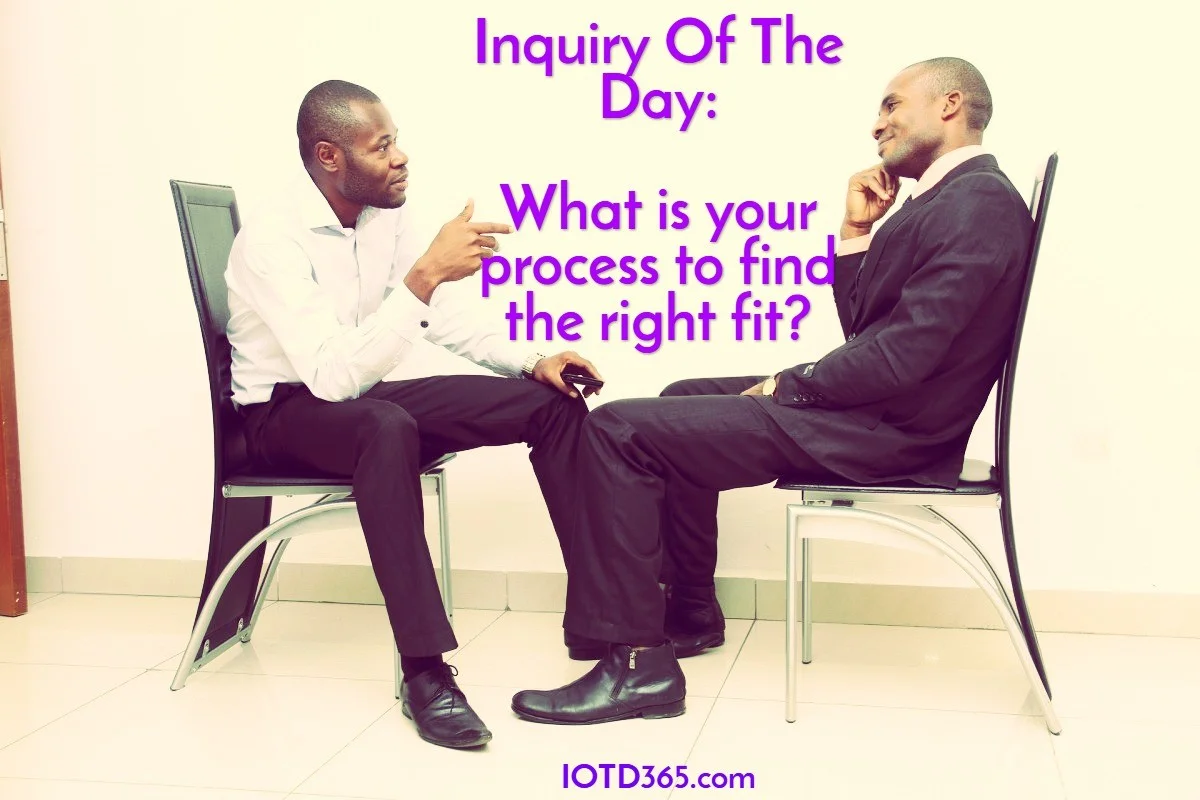
What is your process to find the right fit?

July 29, 2016

The electronic stack of resumes arrive in the inbox ready for your perusal and is generally best paired with an adult beverage. After fighting upper management to defend the budget and fund your new hire; the tough slog of finding the right match ensues. TaskRabbit founder, Leah Busque, stated "hiring's tough. The difficult thing is the nagging feeling that, despite your best efforts, the perfect candidate will somehow fall through the cracks."

The replacement cost is targeted between 16-20% of the annual salary and is a pricey endeavor in time and resources. After all the work, there is still the chance that after a couple of months you find your hiring system and gut instinct was wrong and the new hire isn't the right match. Having been on both sides of the interview, asking the right questions to ensure there is alignment between the hopeful new hire and the prospective company is critical.

If you have been in the game any amount of time, you have refined your skill at determining the best candidate for the position. I am now far more at peace arriving at an interview with a boatload of questions to ensure expectations are understood than when I wore a younger man's clothes. The hiring decision is an opportunity to propel or disrupt the entire team. Beyond finding capable hands to accomplish the work, you are influencing the organizational culture with each new personality. Your current team and customers are counting on you to use your process to correctly discern who to offer a handshake and offer letter; choose wisely.

How much does your gut instinct play a role in hiring a candidate? What are the key "tells" that a candidate is the right or wrong fit? Who were your best/worst hires and what lessons did you learn that you now apply? How has your process changed? What innovative and creative processes do you use to really know the candidate? What are your hiring blind spots that may allow the wrong person to be hired?
In Life Operating System Tags leadership, Leah Busque, TaskRabbit, interview, questions, hiring
Comment

How many questions did you ask last week?

July 9, 2016

40,000 questions in three years. Harvard child psychologist, Paul Harris, determined that children two to five years of age ask about 40K questions and once school starts, the decline begins. The Right Question Institute found that only about 25% of 18 year-olds use questioning on a regular basis. The need to look competent can further limit our questioning once we are engaged in the workforce. The esoteric language of most workplaces includes what feels like a million acronyms that are used in sentences in what sound like alphabet soup if transcribed. I have sat for briefs and not asked for the acronyms to be spelled out thinking I am the only one that was in the dark, only to be asked by someone else on the trip back to the office about the meaning of several acronyms. A similar occurrence has happened with an auditorium full of people when the speaker asks if a particular topic needs an explanation and a single brave soul asks for the explanation to the collective sigh of most of the participants.

What happened between five years old and now? Why did we fall off the questioning cliff? Over the last couple years, classmates do not appreciate my enthusiasm for a topic as I would ask the professor additional questions requiring additional discussion. Generally, I can feel the heat of the stares on my neck, wishing I would just shut-up with the questions. The professor would engage in conversation because there are generally only a few students that will ask questions. I have been known to ask one or two too many questions and frustrate my kids about evening plans, friends or plans for the future. By my count, I am sure it has only happened once.

Paul Sloane posits that asking questions is the single most important habit for innovative thinkers. Mr. Sloane quotes Eric Schmidt, executive chairman of Alphabet, the parent company of Google, as saying "we run this company on questions, not answers.” If our goal is to embrace the future or be innovative in our lives then asking questions need to be a part of our plan. So, what do you think?

Going Further: When did you ask lots of questions? If that has changed, why? How do you handle being asked multiple questions? What prevents you from asking more questions? What other questions should be asked?

In Life Operating System Tags questions, Paul Sloane, Eric Schmidt, Alphabet, Google, innovate, creativity
Comment

What question scares you?

July 6, 2016

Note: This is an uncomfortable post, brace yourself. And yet, another question I have been afraid to post. I hate being afraid. I don't watch horror movies as I have no desire to invest time in something designed to spike cortisol levels or engage fight or flight. If I want to be horrified, I can find plenty of real-world examples that don't require a $15 trip to the movies. I live in an isolated little bubble that doesn't require me to face the things that scare me. I live near I-95 and I am certain that tonight human traffickers are transporting terrified people up and down the east coast to be delivered for terrible purposes to the lowest bidder. What am I doing to stop it? The question scares me because I hate the answer, and I like to think I am better than the honest answer.

Inquiries were not designed to be easy, but to bring about an understanding of one's self and any necessary change. These questions get to the operating system level of who we really are, not the photo-shopped images we post in our profile. Many questions involve those around us both family and co-workers. What employee needs the constructive feedback to improve? What discussion needs to be had with your partner or child? What tough-love needs to be given to that friend who is abusive? What steps do you need to take to face your own fears? What help do we need to change to stop the self-destructive spiral in our own lives?

We have to be intellectually honest with ourselves; if we answer the fun inquiries, the difficult inquiries also get their time in the sun. During a Tim Ferriss podcast discussion with Shay Carl, of YouTube fame, they discussed having a discussion with our 10-year-older self. For example, if you were ten-years-older, what would you say to your current self? This hit me hard. I always have spectacular advice, I would humbly submit, for someone else, but what would my future-self require of my present self and what action is non-negotiable? Yeah, this takes a second to grasp. If we are going to care for our future selves, then fears need to be confronted now, so our future isn't burdened by the same weight as we bear today.

You know the questions, and in most cases, the answers. The question is designed to offer hope that things can be different. Now is the time to answer the question and implement the plan, your future-self anticipates the action.

In Life Operating System Tags afraid, honesty, constructive, courage, Tim Ferriss, Shay Carl, YouTube, questions, planning for the future, future
Comment
The Latest RSS

Latest & Greatest

Featured
Sep 14, 2018
The Home Of Inquiry Has Moved
Sep 14, 2018
Sep 14, 2018
Apr 30, 2017
How have cultural expectations shaped you?
Apr 30, 2017
Apr 30, 2017
Apr 23, 2017
How do you fast?
Apr 23, 2017
Apr 23, 2017
Apr 16, 2017
What are your family memories?
Apr 16, 2017
Apr 16, 2017
Apr 9, 2017
How are others showing love to you?
Apr 9, 2017
Apr 9, 2017
Apr 2, 2017
How do you know your commitment will last?
Apr 2, 2017
Apr 2, 2017
Mar 26, 2017
When do you expand your vocabulary?
Mar 26, 2017
Mar 26, 2017
Mar 19, 2017
How do you forage for positivity?
Mar 19, 2017
Mar 19, 2017
Mar 12, 2017
What are you encouraged about?
Mar 12, 2017
Mar 12, 2017
Mar 5, 2017
How can you use your constraints as an advantage?
Mar 5, 2017
Mar 5, 2017

Engage

These INQUIRIES are here for you.

My intention is for you to ask better questions and think deeper.

Our fast paced, always on, society provides little time for reflection. 

After answering the initial inquiry, dig a little deeper and follow-up with a bit more thinking:

What do I think about it?

How can I make it better/worse?

How does this influence my life and those around me?

How can I be more generous?

© Kenneth Woodward and Inquiry Of The Day (IOTD) 365 (IOTD365), 2016.

Unauthorized use and/or duplication of this material without express and written permission from this site’s author and/or owner is strictly prohibited. Excerpts and links may be used, provided that full and clear credit is given to Kenneth Woodward and IOTD365 with appropriate and specific direction to the original content. Give me a chance to say "Yes".

Powered by Squarespace